


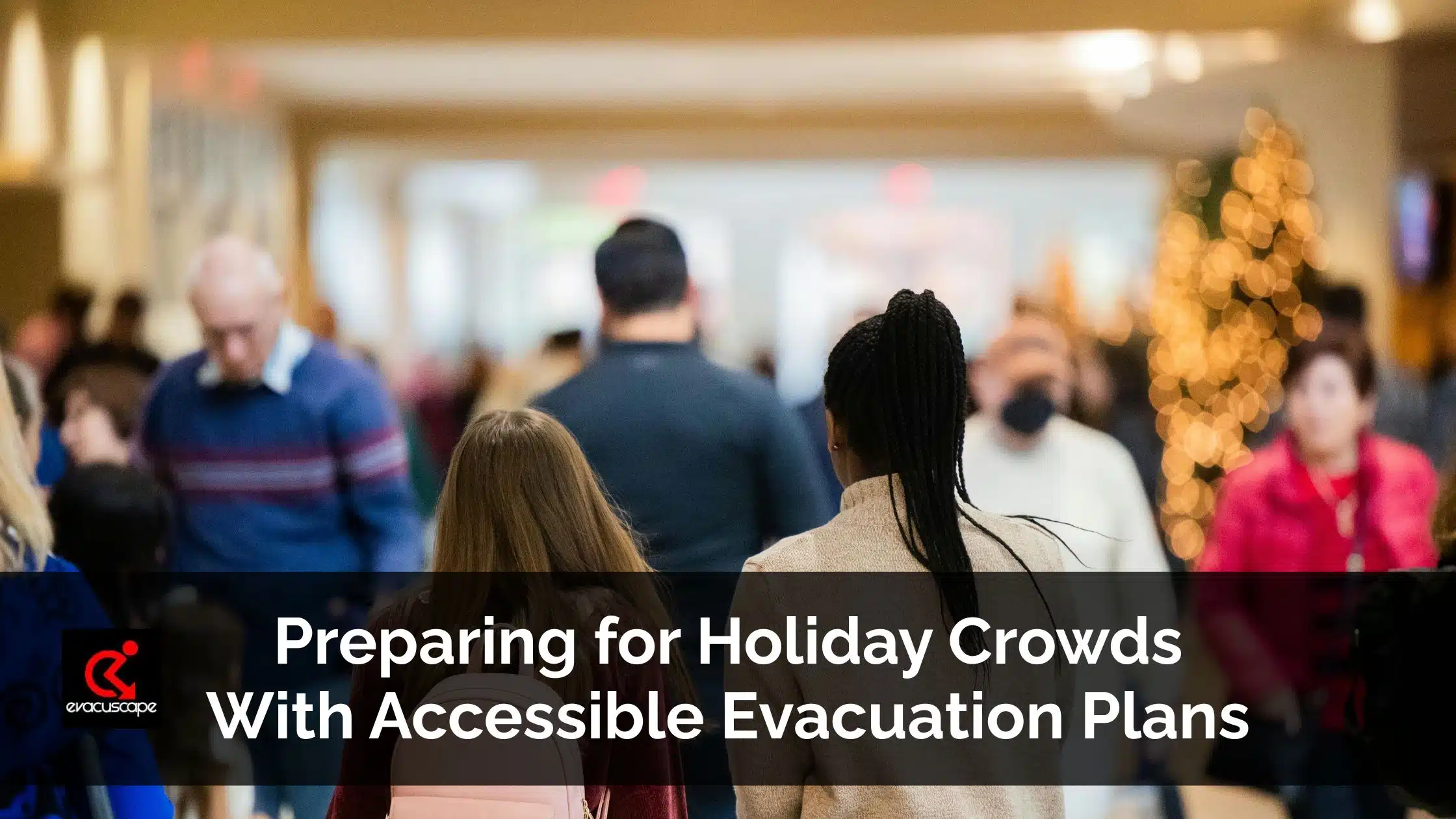
The holiday season brings joy, festivities, and higher risk. Retail malls, community centres, religious venues, convention halls, and event spaces all swell with foot traffic. At the same time, mobility needs do not take a holiday. Seniors, people with mobility impairments, wheelchair users, and visitors with unseen disabilities still expect and deserve safe and dignified exits in emergencies.
This is where accessible evacuation planning becomes more than compliance. It is core to building trust, reputation, and true safety. Evacuscape helps organizations adapt evacuation procedures to seasonal safety challenges. Trusted by businesses, venues, and institutions to keep spaces accessible and compliant year-round, Evacuscape provides leadership in creating safe mobility for all.
In this post, we walk step by step through designing holiday ready, inclusive evacuation plans, anchored in how evacuation chairs from Evacuscape make inclusive emergency preparedness reliable.
Accessible Evacuation Planning: Begin with People
When updating plans for the holiday season, begin not with walls or fire exits but with people.
- Consider peak crowd flow, bottlenecks, distractions, décor, and uneven foot traffic. Where might someone with limited mobility get stuck.
- Gather real data on visitor demographics, wheelchair access, and senior usage.
- Run scenario planning: a fire alarm during a holiday concert, a sudden evacuation at a mall on Boxing Day, or severe weather closure at a community centre.
Your accessible evacuation plan must go beyond exits. It must map inclusive paths, account for areas of refuge, and assume that some individuals cannot use stairs or move quickly.
As the NFPA Emergency Evacuation Guide for People with Disabilities emphasizes, an effective evacuation plan is a living document that must be reviewed and adapted regularly.
Assistive Devices and Support Systems: Elevating Mobility Safety
Evacuscape evacuation chairs are the key foundations of many accessible plans. They work best when integrated into a full system of support.
Why Evacuation Chairs Matter
- They allow safe, controlled descent down stairs for wheelchair users or those unable to walk.
- They preserve dignity and autonomy, eliminating the need to carry someone manually which introduces risks.
- They reduce bottlenecks since trained staff can assist directly without waiting for emergency responders.
Evacuscape’s chairs are trusted solutions that integrate seamlessly, enabling accessible evacuation solutions that scale across venues.
Complementary Support Systems
- Trained personnel or buddies who are prepared to operate chairs and assist users.
- Maintenance and inspection protocols to ensure chairs are tested and ready.
- Backup systems that provide extra chairs or supplementary devices in high traffic areas.
- Transfer training so staff know how to move individuals safely into evacuation chairs.
Stanford’s Guide for Assisting Individuals with Disabilities in an Emergency underlines the importance of respecting preferences. Always ask individuals how they prefer to be assisted rather than assuming.
Building and Infrastructure Considerations
Evacuation is only effective if the path is accessible and maintained.
- Accessible means of egress must be continuous, unobstructed, and fully compliant. They should serve every part of the building, remain clear of obstacles, and allow all individuals, including those with mobility challenges, to exit safely.
- Circulation paths must remain clear. Do not let holiday displays or merchandise block exits.
- Doors should be wide, thresholds should be smooth, and ramps should be functional.
- Areas of refuge must be designated in multi story buildings, allowing those with mobility challenges a safe zone until assistance arrives.
- Lighting, signage, and wayfinding should be highly visible, with alternative formats for accessibility.
- Elevators are usually not an option in emergencies, unless specifically certified for evacuation, so alternate strategies are essential.
The International Code Council reinforces that formal evacuation plans are mandatory for many public and assembly buildings.
Communication and Notification
Even the best plan fails if people do not know about it. During the chaos of holiday crowds, communication is critical.
- Use multi modal alerts: alarms, strobes, text notifications, voice announcements, and signage. ADA emergency planning guidance emphasizes the need for multiple methods to reach people with hearing or vision impairments.
- Provide pre event notices: include evacuation details on websites, programs, and lobby signage.
- Train staff: every staff member should know their role in guiding people, operating equipment, or assisting individuals with mobility needs.
- Use plain language, pictograms, and consistent symbols so instructions are instantly understood.
- Offer real time updates through mobile alerts or PA systems to direct safe crowd flow.
Legislation, Codes, and Best Practices
Compliance is not optional. Many jurisdictions require accessible emergency evacuation.
- ADA Title III Regulations mandate that public accommodations and commercial facilities provide equal access
- Fire and building codes, often adapted from NFPA and IBC standards, outline accessible egress requirements.
- Best practice frameworks, such as the ADAPT planning guide for temporary events, provide actionable guidance for accessible event planning.
- Crowd management standards emphasize the role of managers in keeping exits clear and staff properly trained.
By incorporating Evacuscape’s evacuation chairs, organizations demonstrate that safety is serious and aligned with code friendly solutions.
Roles and Responsibilities in Emergencies
An evacuation plan is only as strong as the people behind it.
- Evacuation coordinators oversee alarms, progress, and communication with emergency services.
- Refuge monitors assist people waiting at safe zones.
- Trained evacuation chair operators deploy chairs quickly.
- Floor wardens direct people toward exits, prevent backflow, and manage crowd flow.
- Assigned buddies or helpers check each area for individuals needing support.
- After action reviewers collect data and feedback to refine the plan.
During the holidays, when foot traffic peaks, these roles may need extra coverage and staff.
Preparation and Personal Emergency Planning
Effective systems must connect with individual needs. Strong emergency planning for businesses means thinking ahead for every scenario, especially during peak holiday seasons.
- Provide self registration or pre-event options for visitors to disclose mobility requirements.
- Offer Personal Emergency Evacuation Plans for regular staff, tenants, or volunteers.
- Conduct live drills that include the use of evacuation chairs and mobility aids.
- Engage stakeholders with disabilities and accessibility experts in both planning and rehearsal.
- Maintain redundancies such as backup equipment and extra staff.
Post Emergency Actions and Feedback
The work does not end when the building is clear.
- Conduct debriefs and gather feedback, especially from individuals with mobility challenges.
- Document bottlenecks, delays, and equipment issues.
- Update the plan immediately based on lessons learned.
- Retrain staff and strengthen weak points discovered in practice.
- Share updates publicly to build trust and transparency.
The NFPA stresses that plans must evolve, and every incident is a chance to improve.
No Room for Last Minute Panic
When holiday crowds swell, the margin for error shrinks. Too many venues treat accessible evacuation as an afterthought, but that is exactly when mobility impaired evacuation matters most.
With Evacuscape’s evacuation chairs, organizations gain proven tools that integrate into comprehensive systems. The true power lies in combining equipment with planning, drills, communication, assigned roles, and feedback. Everything must be tailored to the realities of holiday events.
If you are a facility manager, event organizer, or safety lead, begin now. Reassess foot traffic, upgrade your emergency evacuation equipment, train your team, and rehearse with mobility scenarios. Create an environment where accessible emergency evacuation is embedded into operations, not added at the last moment.
Your patrons deserve holidays where peace of mind is as real as the celebrations. Evacuscape stands ready to support you with evacuation chairs for businesses and inclusive emergency preparedness that works in every season.