


Evacuation Chairs for Property Management
Is Your Building Ready to Evacuate Every Occupant?
Evacuscape evacuation chairs help property managers prepare for accessible, controlled stair evacuations that protect people who cannot use the stairs.
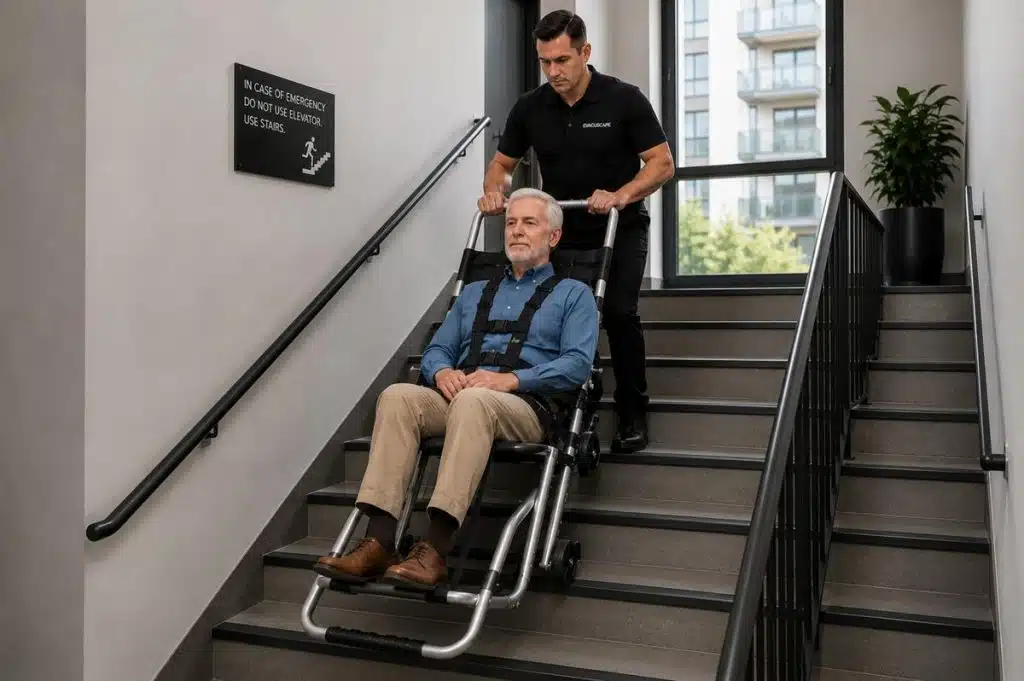
The Standard for Multi-Residence Safety Across North America
From high-rise residential towers in Toronto to sprawling corporate multi-family portfolios across New York, premier property groups trust Evacuscape to protect their residents, staff, and reputation. Join the leaders in emergency preparedness and ensure your community is safe and secure in any situation


Proactive Property Management Emergency Preparedness
When an unexpected outage or structural alarm grounds your elevators, your safety policies are immediately put to the test. If an evacuation happens in the middle of the night, your leasing office is empty, leaving no one to help manage an evacuation safely. Vulnerable occupants are left waiting on a landing while emergency crews arrive, or relying on untrained neighbors to handle an evacuation. Deploying a specialized emergency chair for evacuation allows you to completely alleviate this risk, providing reliable emergency evacuation equipment that helps your team safely transport people with limited mobility out of the building.
Engineered for Fast, Confident Property Response
Designed for demanding commercial and multi-family environments, our property management evacuation chairs integrate seamlessly into existing emergency evacuation planning for property managers and preventive maintenance schedules. These heavy-duty emergency evacuation solutions for property management allow your building emergency team to execute swift life-saving protocols during real-world disaster scenarios like fires, flooding, or severe natural disasters. This ensures your properties stay aligned with modern accessibility emergency evacuation benchmarks without relying on unsafe manual lifting in narrow stairwells.
Get a Free Quote Today
Protect Every Occupant With Accessible Evacuation
When elevators are out of service, every resident still needs a safe way out.
In an emergency, every second depends on preparation. A strong emergency response plan outlines evacuation procedures, establishes a clear chain of command, assigns roles and responsibilities, and ensures building staff know exactly how to respond. But when someone cannot safely use the stairs, even the most organized response can slow down without the right equipment in place.
Evacuscape evacuation chairs give building teams a safe, controlled way to assist residents when elevators can’t be used. Designed for apartment, condominium, and commercial properties, they help property managers improve accessible evacuation, giving staff greater confidence to evacuate occupants with mobility limitations safely when every second counts.
Real Estate Safety Starts With Asset & Occupant Preparedness
Every multi-family property presents unique structural liabilities, from tenant turnover to unmonitored stairwells that become primary escape routes during a crisis. Evacuscape provides heavy-duty emergency equipment that helps operators protect vulnerable residents, fulfill corporate duty of care, and defend the asset against costly negligence claims.




The Lifesaving Impact of Evacuation Chairs for Rental Properties
During an emergency evacuation, older adults, residents recovering from surgery, wheelchair users, people using walkers or other mobility aids, and individuals living with temporary or permanent disabilities may all need assistance. Emergency response plans should account for how these residents will safely leave the building if elevators are unavailable and stair evacuation becomes necessary.
Evacuscape evacuation chairs give trained staff a safe, controlled way to assist residents during stair evacuations. Lightweight, easy to deploy, and designed for single-operator use, they help reduce physical strain with accessible evacuation that enhances tenant safety. The strongest emergency response plans combine the right equipment with clear evacuation procedures, defined staff roles, and reliable tenant communication strategies. Together, they help building teams respond more efficiently while ensuring residents understand evacuation routes, meeting points, and what to expect during an emergency.
The Lifesaving Impact of Evacuation Chairs for Rental Properties
A fire alarm changes the building in seconds. Elevators lock out. Stairwells fill. Add smoke, limited visibility, or emergency evacuations with pets, and helping someone who can’t use the stairs safely becomes far more difficult. Evacuscape evacuation chairs turn uncertainty into a clear evacuation procedure.
One-Person Operation
Designed for single-operator use, making it easier for building teams to assist residents while reducing the need for manual lifting during an emergency.
Supporting Every Resident
Help older adults, wheelchair users, residents using mobility aids, and people with temporary injuries evacuate more safely when stairwells become the only exit.
Ready When Needed
Lightweight, foldable, and easy to access near stairwells, so evacuation equipment is available when every moment of your emergency response matters.
Fits Your Emergency Plan
Easily integrates into evacuation procedures, staff training, tenant communication strategies, and routine emergency preparedness planning.
Seamless Operations Integration
Easily integrates into standard building evacuation procedures, ongoing staff onboarding, tenant communication strategies, and routine emergency preparedness planning.
Built for Multi-Residential Buildings
Purpose-built for apartment buildings, condominiums, rental properties, retirement residences, and mixed-use developments with changing occupant needs.
The Reality of Multi-Story Exit Scenarios
Multi-family properties face intense logistical hurdles during a crisis. Occupants must exit under extreme pressure, elevators shut down automatically, and stairwells quickly become crowded. Relying on written policies or waiting for first responders leaves your building exposed. True property management emergency preparedness requires physical tools designed to handle these exact operational pressures.
Diverse Occupant Demographics
Your building is likely home to a variety iof individuals, including seniors, pregnant women, and residents dealing with temporary or permanent mobility challenges. Deploying specialized accessibility emergency evacuation tools ensures a single operator can guide these individuals down safely, without the danger of manual lifting.
Time-Sensitive Realities
A single delay in a crowded stairwell can quickly spark widespread resident panic and stall your entire exit timeline. Utilizing heavy-duty stair evacuation chairs keeps the flow of people moving steadily downward, letting your team control the situation when pressure climbs.
High-Occupancy, Multi-Level Buildings
Modern high-rises and condominium communities are full of narrow corridors, heavy fire doors, and tight, winding stairwells. Installing targeted evacuation equipment for condos and apartment buildings ensures your team has a real, physical way to protect every resident on every floor.
Minimal Off-Peak Staffing
Most residential emergencies happen overnight, right when your on-site maintenance and leasing teams are at their thinnest. Having dedicated property management evacuation chairs allows a lone night-shift worker or even a tenant volunteer to step in and assist a neighbour instantly.
High-Occupancy Traffic
The moment the alarms sound, your elevators shut down automatically and force every resident into the stairwells at the same time. Deploying dedicated emergency evacuation solutions for property management at your exit doors keeps the crowd moving safely and prevents dangerous stairwell overcrowding
Complex Architectural Layouts
Modern high-rises and condominium communities are full of narrow corridors, heavy fire doors, and tight, winding stairwells. Installing targeted evacuation equipment for condos and apartment buildings ensures your team has a real, physical way to protect every resident on every floor.
Don’t Leave Occupant Safety to Chance
Make accessible evacuation part of your emergency response plan with equipment designed for fast and secure exits.
Legal & Regulatory Compliance: Safety Standards & Compliance for Property Management
Property managers must implement comprehensive emergency plans, including accessible evacuation procedures for Persons with Reduced Mobility (PRM), to ensure safety during power outages or structural alarms. Integrating specialized evacuation chairs into life safety strategies facilitates controlled stair descents, strengthening disaster preparedness and compliance with local building and fire codes.
Deploying these units actively reinforces condo and apartment building safety by providing an immediate, reliable descent solution during sudden fire evacuations or unexpected elevator outages. Evacuscape chairs are officially CE certified and registered with the FDA.
- Supports ADA & AODA accessibility planning initiatives across all multi-story portfolios.
- Strengthens property management emergency preparedness for sudden elevator failures.
- Integrates into emergency response plans and real-world disaster scenarios.
- Assists with the safe evacuation of Persons with Reduced Mobility (PRM) without manual lifting.
- Supports documented duty-of-care responsibilities to minimize costly corporate negligence claims.
- Reinforces staff training, scheduled drills, and clearly assigned evacuation procedures.
- Complements evacuation routes, emergency exit planning, and proactive corporate accessibility strategies.
- Supports ongoing safety inspections, insurance audits, and comprehensive preparedness planning.
Essential Equipment for Safer Property Evacuations
Evacuscape chair models combine durable construction, ergonomic design, and dependable performance to make safe descent a reliable, friction-controlled part of your emergency response plan.

EC1 Evacuation Chair
Our lightweight, standard solution built for rapid deployment during emergency building evacuations. A single operator can smoothly guide an occupant up to 400 lbs down flights of stairs with complete confidence, utilizing a weight-bearing friction track system that controls the descent speed for you.
EC2 Evacuation Chair
Our premium model is engineered with an innovative, fail-safe manual braking system and integrated LED lighting. Ideal for high-density towers and busy commercial spaces where enhanced descent control and maximum visibility are critical during low-light power outages.

Evacuation FAQs for Property Management
Do we need two employees to operate an Evacuscape chair?
No. For descending stairs, Evacuscape evacuation chair models are designed for single-operator use. The weight-bearing friction tracks and controlled descent system allow a lighter operator to safely manage a heavier passenger without manual lifting. A second person is only needed if an occupant must be lifted upward over stairs or barriers, not for standard downward stair evacuations. This single-operator design supports emergency response planning where staffing may be limited, while still prioritizing occupant safety and inclusive evacuation outcomes.
How do evacuation chairs fit into our emergency response plan?
Evacuation chairs become a defined part of your emergency response plan, alongside evacuation procedures, emergency resources, and life-saving protocols. They should be included in your emergency response plan template, with clear roles and responsibilities for who operates them, where they are stored, and how they are used during different disaster scenarios. When combined with a communication plan, training, maintenance and regular inspections, they turn stair evacuation for Persons with Reduced Mobility (PRM) into a predictable, planned process rather than an improvised response.
What communication planning should we do around evacuation chairs?
Communication planning should explain to staff and occupants how evacuation chairs will be used and where they are located. This includes tenant communication strategies, message templates, and notification channels that reference evacuation routes and meeting points. Assigning a communication commander and clarifying communication protocols help ensure alert systems and community communication remain clear before, during, and after emergencies. When people know what equipment is available and how it will be used, emergency communication schemes feel more organized and reassuring.
Who needs to be trained to use evacuation chairs?
Training should include members of your building emergency team, security staff, health and safety professionals, and designated route guides or incident commanders. Annual training and drills help staff practice emergency procedures, chair deployment, and stair navigation so they can operate equipment confidently under pressure. Training also supports your chain of command and coordinated actions during emergencies, reinforcing that evacuation chairs are essential emergency equipment, not optional accessories.
How do evacuation chairs support compliance and duty of care?
Evacuation chairs help organizations demonstrate compliance with accessibility and life safety expectations by providing a practical way to evacuate PRM when elevators are unavailable. Documenting their use in emergency procedures, roles and responsibilities, and maintenance reports shows a clear duty of care to occupants, insurers, and regulators. By aligning equipment with local regulations, threat assessment, and emergency risk management strategies, evacuation chairs support both universal fire safety and inclusive evacuation planning across retirement homes,commercial buildings, and multi-residential buildings.
What maintenance and inspections do evacuation chairs require?
Evacuation chairs should be included in routine inspections and preventive maintenance schedules, just like other safety equipment. Regular checks confirm that emergency devices are operational, correctly mounted or stored, and free from damage. Maintenance reports, insurance inspections, and security audits can reference evacuation chairs alongside fire alarms, smoke detectors, and carbon monoxide detectors, reinforcing that your mechanical and life safety systems are ready for emergencies. Consistent maintenance supports reliable performance when chairs are needed most.
How do evacuation chairs affect insurance and financial preparedness?
Including evacuation chairs in your evacuation plans and emergency preparedness documentation can strengthen conversations with your insurance provider and insurance agents. Demonstrating that you’ve considered PRM and stair evacuation in fires, flooding, earthquakes, and other disasters shows proactive risk identification and emergency risk management strategies. This can help reduce potential losses and support more favourable insurance coverage, while aligning with landlord insurance policy requirements and broader business continuity planning.
Can evacuation chairs be used in different types of emergencies?
Yes. Evacuation chairs support safe stair evacuation in a range of disaster scenarios, including fires, power outages, natural disasters, and security threats where elevators may be shut down. They work alongside fire extinguishers, fire safety equipment, shelter-in-place procedures, and security systems as part of a comprehensive emergency protocols framework. Because they focus on occupant movement, they complement other emergency resources and help ensure evacuation procedures can be carried out for occupants with reduced mobility in many potential emergencies.
What makes the EC2 model different from other evacuation chairs?
The EC2 model includes a unique fail-safe brake system and integrated LED lighting, offering greater control and visibility during stair evacuations in low-light or smoke conditions. This design helps operators manage descent speed more precisely and maintain stable movement, which is especially valuable in high-rise, condominiums or comercial buildings. Like other Evacuscape chairs, the EC2 is built for universal design and inclusive safety, focusing on protecting all occupants during emergencies and improving evacuation outcomes for PRM and other at-risk individuals.
How do evacuation chairs support insurance and reduce our risk during disasters?
Evacuation chairs strengthen your evacuation plans by showing you’ve considered how to safely move people with reduced mobility during fires, floods, earthquakes, tornadoes, and other disasters. When you document chairs as part of your emergency resources and safety equipment, they become a visible part of your insurance plans and risk management strategy. Many insurers look favourably on properties that plan for safe stair evacuation, because it can reduce losses to both people and assets when evacuation routes are needed quickly. Having accessible evacuation equipment in place supports stronger insurance coverage conversations and demonstrates a proactive approach to protecting occupants and property.
How do evacuation chairs integrate with the emergency contact list and communication plan for our building?
Evacuation chairs serve as the physical link between your communication command and your on-site team during an evacuation. When an emergency occurs, your incident commander utilizes your building’s alert systems to coordinate with incoming emergency responders, including the fire department, police, and emergency medical services (EMS). By maintaining an updated emergency contact list, complete with tenant contact information, first responder information, critical healthcare providers, and your insurance agents, your team can instantly deploy your stair evacuation chairs to the exact units housing residents with limited mobility before emergency services even arrive on-site.
Prepare Your Building Before an Emergency Happens
Protect Your Occupants, Guard Your Asset
Help ensure every resident has a safe way out with evacuation equipment designed for controlled stair descents.

