


Not every emergency calls for the same response. Some situations make it dangerous to leave a building. Others make it dangerous to stay. Knowing the difference, before an alarm ever sounds, is what separates a calm, controlled evacuation from a chaotic one.
This guide breaks down the type of evacuation that applies to different emergencies, walks through the types of fire evacuation specifically, and looks at how to plan for occupants who need extra support along the way.
Types of Evacuation
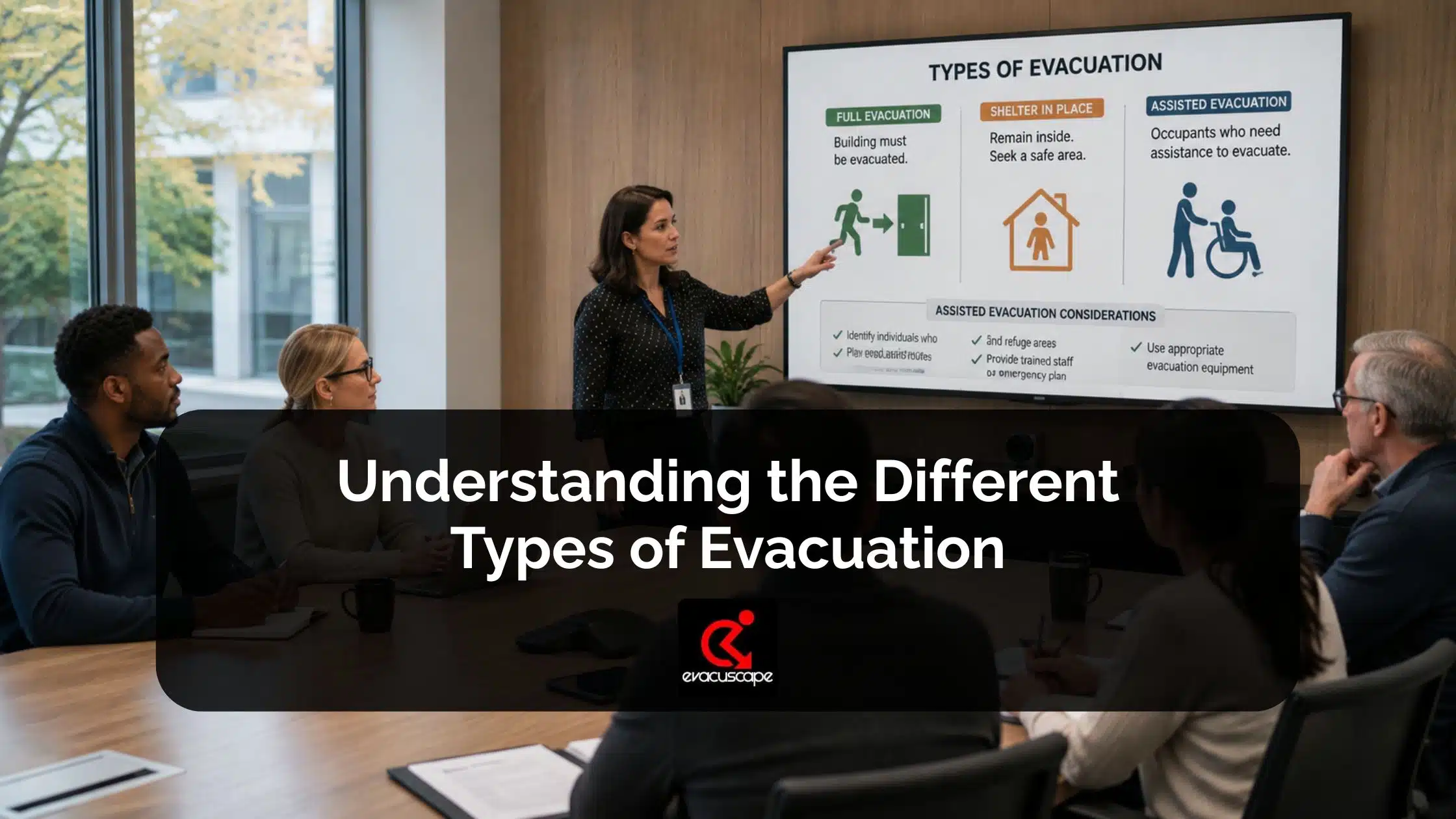
So what are the 4 types of evacuation most buildings need to prepare for? They generally fall into four categories, scaled by how far occupants need to travel to reach safety.
Stay in Place
A stay in place, or shelter in place, order applies when leaving the building is riskier than staying inside it. Occupants may be asked to move to a specific floor or room and remain there, sometimes for hours, while the emergency plays out. This is closely related to what is often referred to as a lateral evacuation, one of the stages of evacuation that buildings should plan around.
Common triggers include an active threat outside the building, severe weather such as tornadoes or flash floods, or a chemical release nearby. Even during a stay in place order, occupants with mobility challenges may still need to move within the building, whether that means going up a flight of stairs or across a floor to reach a safer room. A stair evacuation chair makes that internal movement possible for people who cannot manage stairs on their own, even when a full building evacuation is not yet underway.
Building Evacuation
A building evacuation is necessary when staying inside puts occupants at direct risk. This applies to any structure, from a single family home to a high-rise office tower. Common causes include fires, gas leaks, and structural damage that compromises the building’s integrity. Evacuation drills also fall into this category, since they require the same full exit process without an actual emergency behind them.
Vertical movement is often the hardest part of a building evacuation, particularly in taller properties where power outages can disable elevators mid-emergency. That leaves stairs as the only reliable route down, which is exactly where a dedicated evacuation chair becomes essential for anyone who cannot safely descend multiple flights unaided.
Community Evacuation
A community evacuation covers a wider area than a single building, such as a neighbourhood, a campus, or a business park. Fires, credible threats of violence, and oncoming severe weather can all trigger this type of evacuation. Normal mobility aids like elevators or escalators are often unusable in these situations, and moving through large, fast moving crowds adds another layer of difficulty for anyone who cannot move quickly. Portable evacuation equipment matters here too, since it allows vulnerable occupants to be moved safely without depending on vehicles or infrastructure that may already be overwhelmed.
City Evacuation
A city-wide, or mass, evacuation is the largest scale response, typically reserved for major natural disasters, infrastructure failures, or widespread threats to public safety. Authorities do not call for this lightly. When it happens, every stage of evacuation that applies to individual buildings and communities still applies, just compressed into a much shorter window and a much larger population.
Types of Fire Evacuation
Fire emergencies deserve their own breakdown, since not every fire calls for the same evacuation strategy. Understanding the different approaches to fire evacuations helps building managers choose the right response for their specific property.
Full or total evacuation clears the entire building at once and is the most common approach for smaller properties or lower risk buildings, where every occupant can reasonably exit through the same set of routes.
Phased or partial evacuation is used in larger high-rise buildings, where evacuating every floor simultaneously would overwhelm stairwells. Instead, the floor closest to the fire evacuates first, followed by floors immediately above and below, while the rest of the building waits for further instruction.
Defend in place keeps occupants in a fire-resistant area of the building, often used in hospitals or care facilities where moving patients quickly is more dangerous than the fire itself, at least in its early stages.
Horizontal evacuation moves occupants sideways into a separate, fire-protected section of the same floor rather than down a stairwell, buying time until a full evacuation becomes necessary or until the threat is contained.
In every one of these scenarios, elevators should generally be avoided unless fire services have directed otherwise. That makes stairs the default evacuation route in most fire scenarios, and it is exactly why evacuation chairs are considered essential equipment in any building taller than a few storeys.
Evacuation for Vulnerable Individuals (PEEPs)
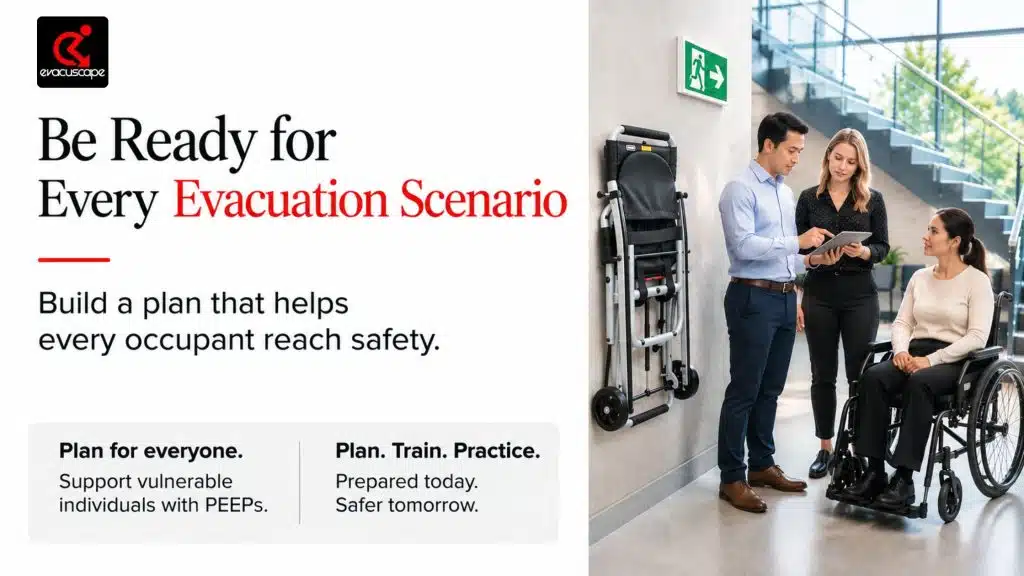
Not every occupant can follow a general evacuation plan at the same pace. A Personal Emergency Evacuation Plan, or PEEP, is a documented, individualized plan built for a specific person who may need assistance to reach safety, whether due to a permanent disability, a temporary injury, a pregnancy, or another condition that affects their ability to evacuate independently.
A good PEEP identifies the person’s specific needs, the route they will take, the equipment required, and who is responsible for assisting them. It should be developed with the individual directly, reviewed regularly, and practiced just like any other evacuation drill. Buildings that serve seniors, patients, students, or the general public all benefit from having PEEPs in place well before they are ever needed.
Evacuation Procedures and Planning
A strong evacuation plan accounts for every type of evacuation covered here, not just the most common one. That means planning for an emergency well in advance, mapping out primary and secondary routes, identifying safe rooms or areas of refuge, and making sure equipment like evacuation chairs is stored where it can actually be reached during a crisis. It also means taking concrete steps to prepare your building, from clearing stairwells of obstructions to confirming signage and lighting are functioning correctly.
Evacuation Training and Drills
Plans only work if the people relying on them know how to execute them. Regular drills, covering both standard evacuations and assisted evacuations using equipment like stair chairs, keep staff and building occupants prepared rather than caught off guard. Drills should be varied to reflect different scenarios, a full building evacuation one quarter, a phased fire evacuation the next, so that no single response becomes the only one people are ready for.
Best Practices and Safety Recommendations
A few habits separate buildings that handle emergencies well from those that struggle. Keep evacuation routes clear at all times. Review and update PEEPs whenever an occupant’s needs change. Store evacuation chairs in accessible, clearly marked locations near stairwells. Train new staff on evacuation procedures as soon as they join, rather than waiting for the next scheduled drill. And treat every type of evacuation as equally important to plan for, since the one a building is least prepared for is often the one it eventually faces.
Understanding the different types of evacuation is not just theoretical knowledge. It is the foundation that turns a chaotic emergency into a controlled, safe response for everyone in the building, including the people who need help getting there.