


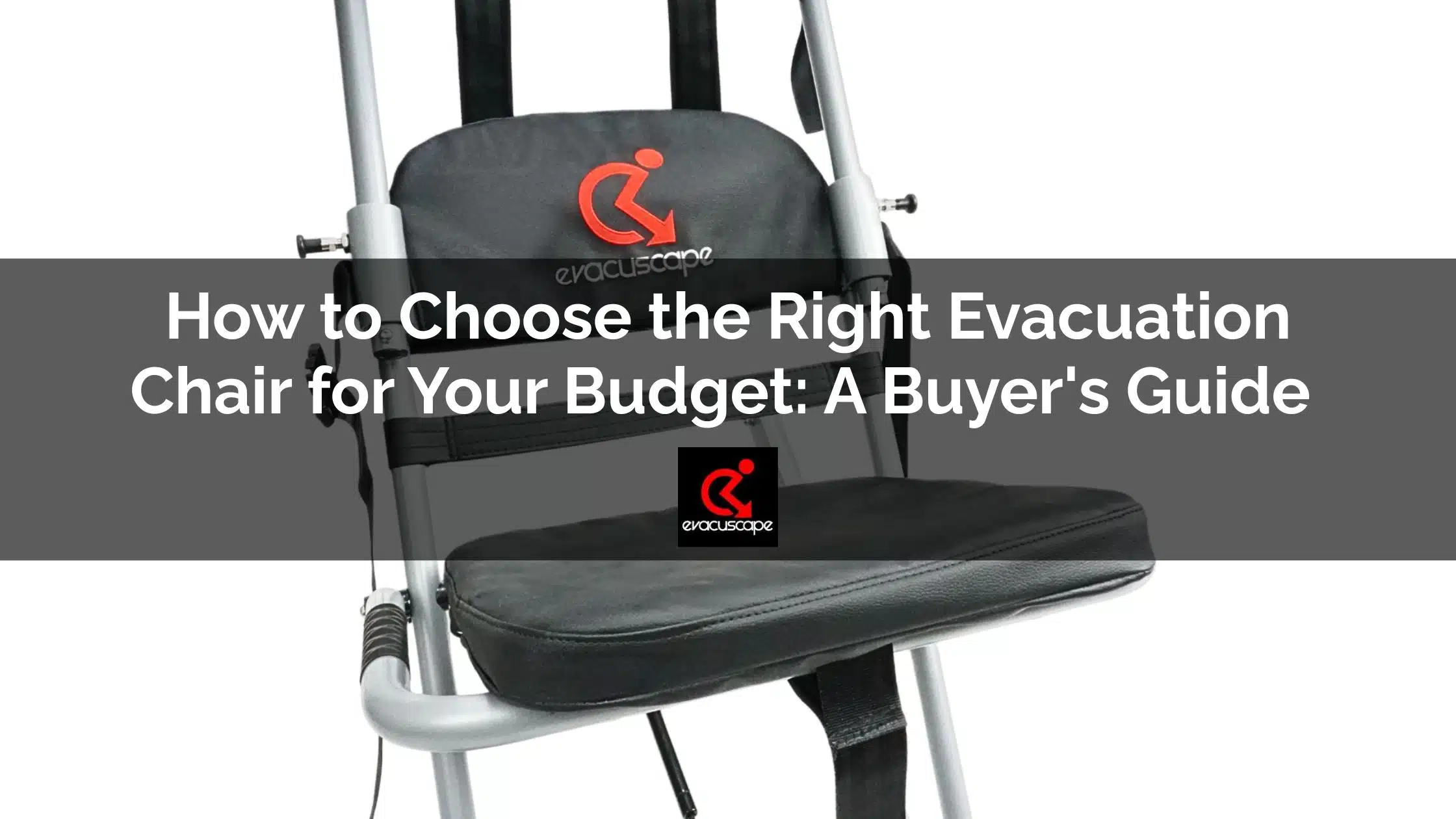
Choosing the right evacuation chair is not simply a purchasing decision. It is a safety decision that directly shapes how people are protected in an emergency.
Whether you are responsible for a commercial building, healthcare facility, or public space, the goal is not to find the lowest price. It is to find the right balance between reliability, usability, and cost. Because in a real evacuation, performance is not negotiable.
This guide walks you through how to choose an evacuation chair based on your budget, building type, and safety requirements, while helping you understand the trade-offs that actually matter.
Why Evacuation Chairs Are a Critical Part of Emergency Planning
Evacuation chairs exist to solve a very specific problem. When elevators are unavailable and stairwells become the only exit route, individuals with limited mobility still need a safe way out.
Without the right equipment, evacuations become inconsistent, physically demanding, and in many cases, unsafe. Evacuation chairs provide controlled descent, stability, and structured support, allowing trained staff to assist quickly and with confidence.
Guidance from the Government of Ontario also highlights the importance of evacuation equipment for individuals with disabilities, particularly in multi-level buildings where stair access becomes critical during emergencies.
This is why they should never be treated as a simple compliance item. They are part of a broader safety strategy. When integrated into emergency evacuation planning for businesses, they ensure that evacuation procedures are inclusive, consistent, and realistic under pressure.
Start With Purpose Before You Think About Price
The biggest mistake buyers make is starting with budget instead of context. Before looking at models or pricing tiers, define how the chair will actually be used. A high-rise office, a long-term care facility, and a school all have very different evacuation dynamics. The number of floors, the layout of stairwells, and the mobility needs of occupants all influence what type of equipment is appropriate.
Once that context is clear, the budget becomes easier to navigate. You are no longer choosing between expensive and inexpensive. You are choosing between suitable and unsuitable.
If that process feels unclear, working with a reputable provider like Evacuscape can help translate your building requirements into practical, safety-first solutions. You can learn more about Evacuscape on our site and reach out to our specialists for assistance.
Understanding the Different Types of Evacuation Chairs
Not all evacuation chairs are designed for the same environments, and this is where many buying decisions start to take shape.
Manual evacuation chairs are often the most budget-friendly option. They rely more heavily on the operator for control and require a higher level of physical involvement. In lower-demand environments, they can be a practical choice.
Tracked stair descent chairs are more commonly used across commercial and institutional settings. Their friction-based track systems provide smoother, more controlled descent, reducing strain on the operator while improving stability for the passenger.
Powered evacuation chairs sit at the higher end of the pricing spectrum. They are designed for environments where frequent use is expected or where additional assistance is needed. The motorized support reduces physical demand and can improve efficiency in complex evacuations.
Each type serves a purpose. The decision is not about which one is best overall, but which one aligns with your environment and your team.
Research from RESNA also highlights how different evacuation devices, including track-based chairs, are designed to support safe and controlled descent depending on building conditions and user needs.
What Actually Drives Evacuation Chair Pricing
At a glance, evacuation chair price differences can seem arbitrary. In reality, they are driven by specific design and performance factors.
Materials, build quality, and engineering all play a role. Chairs designed for higher weight capacities or frequent use require reinforced construction. Advanced braking systems and controlled descent mechanisms add both cost and reliability. Features that improve ease of use, such as smoother maneuverability or ergonomic design, also influence pricing.
Lower-cost models often meet basic functional requirements but may require more effort to operate and offer fewer safety enhancements. Higher-end models are engineered for consistency, especially in high-pressure environments where performance must remain predictable.
If you take the time to compare evacuation chair options, the real distinction becomes clear. You are not just paying for features. You are investing in how the chair performs when it matters most.
Your Building Layout Should Shape Your Decision
An evacuation chair does not operate in isolation. It operates within your building. Staircase width, landing size, number of floors, and corridor spacing all influence how effective a chair will be in practice. A model that works seamlessly in a wide, modern stairwell may struggle in a tighter or older layout.
This is where building compatibility becomes critical. The goal is not to choose a chair that works in theory. It is to choose one that works in your exact environment, under real conditions.
Government of Canada emergency planning resources also recommend placing evacuation equipment such as chairs near stairwells, ensuring they are accessible and ready for immediate use when elevators are unavailable.
As part of that process, many organizations choose to prepare your building for an emergency evacuation at the same time, ensuring that both equipment and procedures align.
The Features That Matter When It Counts
Specifications can be overwhelming, but not every feature carries equal importance. The most valuable features are the ones that directly impact safety and usability during an actual evacuation. Controlled descent systems are essential for maintaining stability on stairs. Secure harnesses and proper support ensure the passenger remains safe throughout the process. Weight capacity must be inclusive enough to accommodate a wide range of users.
Equally important is how the chair is stored and deployed. A compact, foldable design allows for quick access without obstructing pathways. Durability also plays a critical role. Emergency equipment must perform consistently, even after long periods of storage.
Understanding what to look for in an evacuation chair helps filter out unnecessary details and focus on what truly affects performance.
Ease of Use Is Not Optional
In an emergency, clarity and simplicity matter more than anything else. An evacuation chair should be intuitive to deploy and operate. Complicated mechanisms or unclear controls can slow down response times and introduce risk. The operator should be able to act quickly, with minimal hesitation.
Maneuverability also plays a key role. Navigating stairwells, landings, and tight corridors requires equipment that responds smoothly and predictably. The less effort required to operate the chair, the more effective it becomes in real scenarios.
This is where design quality becomes evident. A well-designed chair does not just function. It supports the operator in doing their job efficiently and safely.
Compliance Is the Baseline, Not the Goal
Many organizations begin their search because of regulatory requirements. While compliance is important, it should not be the final benchmark.
Meeting standards ensures that you are aligned with guidelines, but it does not guarantee that your equipment is suited to your building or your team. Real-world performance depends on how the chair integrates into your evacuation plan and how confidently it can be used under pressure.
Accessibility guidance in Canada also emphasizes that evacuation procedures must account for assisted egress, including the use of specialized equipment like evacuation chairs to support safe movement during emergencies.
A stronger approach looks beyond compliance and focuses on preparedness. If you want to explore your options with Evacuscape, please note that our focus is on practical application and ensuring that equipment performs where it matters most.
Training Turns Equipment Into a Real Solution
Even the most advanced evacuation chair cannot replace proper training. Staff need to understand how to deploy the chair, how to assist individuals safely, and how to remain calm during an emergency. Training builds confidence and reduces hesitation, both of which are critical in high-pressure situations.
Without it, even well-designed equipment can become difficult to use effectively. With it, evacuation procedures become smoother, faster, and significantly safer.
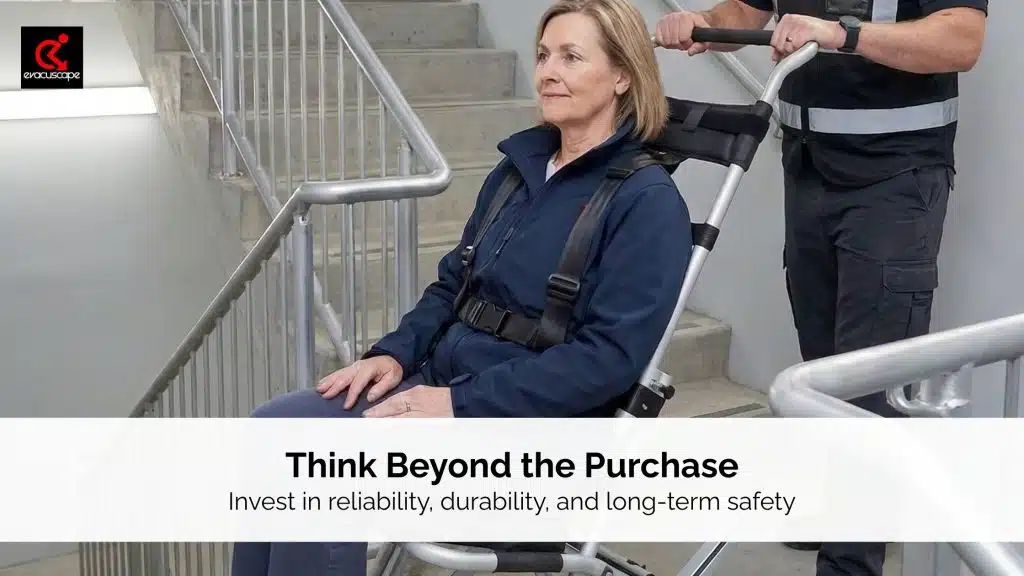
Think Beyond the Purchase Price
An evacuation chair is not a one-time decision. It is part of an ongoing safety investment. Maintenance, storage, and long-term durability all influence the true cost. Equipment that is well-maintained and properly stored will perform more reliably and last longer. This reduces the need for replacement and supports better long-term value.
When evaluating options, it is worth stepping back and considering total ownership, not just upfront pricing. The right investment is one that continues to deliver reliability over time.
Choosing With Confidence
The right evacuation chair is the one that aligns with your building, your team, and your safety priorities. It supports real-world use, not just theoretical scenarios. It balances cost with performance in a way that feels practical and sustainable. And most importantly, it ensures that everyone in your building has a clear and safe path during an emergency.
If you are ready to take the next step, you can contact our evacuation safety team to get guidance tailored to your specific environment.
Final Thought: Preparedness Over Price
This decision is about preparedness, and choosing equipment that performs under pressure, supports your team, and protects the people in your building. Price will always be part of the conversation, but it should never be the deciding factor on its own.
Broader emergency planning frameworks, such as those outlined by the NFPA, reinforce that inclusive evacuation strategies must account for individuals with mobility challenges and provide appropriate equipment and training to support safe exit.
The right evacuation chair is not simply the one that fits your budget. It is the one that ensures you are ready when it matters most.